4820 Birney Ave, Moosic, PA 18507
Contact Us Today: 570-457-7711

- Lightning-Fast Lead Times
- Exceptional Customer Service
- Highest Quality Products
- Competitive Pricing
Carrier Design Options
View the PDF
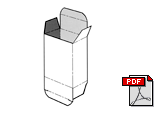
Standard ReverseTuck (SRT)
Standard Reverse Tuck (SRT) The standard reverse tuck has the manufacturer’s joint in the right rear corner. The top closure tucks from the rear to the front, and the bottom closure tucks from the front to the rear.
Shown here is a friction lock top closure (easy to open and reclose) and a slit (pie) lock tuck bottom which is more secure and less likely to disengage.
View the PDF
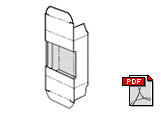
Standard Straight Tuck (SST)
The standard straight tuck is particularly well suited for products requiring a large window in the front display panel. Typically, both closures will tuck from the front to the rear, which avoids a raw edge showing at either end of the primary display panel. It also prevents possible interference between the tuck and the window film material, which could occur with a reverse tuck. This style is equally well suited for hand erecting and closing, or machine forming and closing.
View the PDF
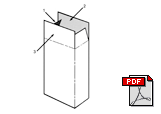
Full Overlap Seal End (FOSE)
The full overlap seal end (FOSE) is typically erected, filled and closed on automatic horizontal or vertical packaging equipment. The normal closing sequence is: Dust flaps in first, inner closure panels (off the rear panel) down next, and outer closure panels (off the front panel) down last (Figure 2). The sift resistant characteristics of the FOSE may be enhanced by making minor changes to the design and folding sequence of the end closure and flaps.
View the PDF
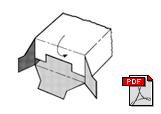
1-2-3 Bottom (a.k.a.) Houghland or Snap Lock Bottom
This style originally identified by the inventor’s name (Houghland) is today for frequently referred to as the 1-2-3 closure. It is used almost exclusively as a bottom closure, generally in combination with a tuck top closure. This is a hand erected and closed style. In addition to use in the variation shown below, the 1-2-3 closure is frequently used as the bottom closure for a shallow depth tube style counter display carton.
View the PDF
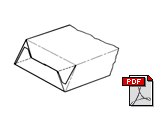
Himes Lock, Automatic Bottom (a.k.a) Crash Lock, Economy or Popcorn Bottom
The Himes or crash lock automatic bottom is preglued in the converter’s plant. It is hand erected and typically used where fast set up is critical, but production volume does not justify an investment in automatic packaging equipment.
View the PDF
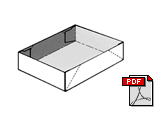
Four Corner Beers Tray (a.k.a.) Biers Tray
The Beers tray is glued by the converter and shipped flat to the customer. It is typically set up and loaded by hand. Figures 1 and 3 show the conventional Beers. Figure 2 shows the “stay-up” or “full drag” version. Combination of a side panel diagonal angle of less than 45° (43-1/2° typically) and a non-tapered glue flap causes the glue flap to “drag” across the bottom panel. Natural friction causes the carton to resist collapsing once erected.
View the PDF
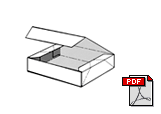
Four Corner (Point) Beers with Tuck Top Closure (a.k.a.) Biers
This style is typically set up, loaded and closed by hand. It is suitable for a broad range of relatively light products.
View the PDF
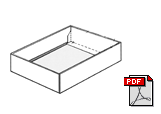
Simplex Tray
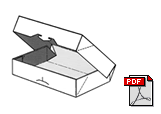
View the PDF
Six Corner Tray
The six corner Beers tray is glued by the converter and shipped flat to the customer. It is typically setup and loaded by hand.
A variation on this basic style includes conventional Beers corners at the front of the base tray and front cover.
Copyright ©2026 NEPA Carton & Carrier Co. Inc. | All Rights Reserved